Raptor Resources (RAP:AU) has announced Raptor Completes Further Drilling at Chester Project
Download the PDF here.
This post appeared first on investingnews.com


Raptor Resources (RAP:AU) has announced Raptor Completes Further Drilling at Chester Project
Download the PDF here.

Red Mountain Mining Limited (ASX: RMX, US CODE: RMXFF, or “Company”), a Critical Minerals exploration and development company with an established portfolio in Tier-1 Mining Districts in the United States and Australia, is pleased to announce an update on the Company’s portfolio of high-quality Antimony projects in the United States.
Over the past six months, Red Mountain has moved decisively to acquire assets in Tier-1 regions in highly prospective antimony mineral districts in Montana, Utah and Idaho, USA, placing the Company in a strong strategic position as the US Government moves aggressively to secure domestic supply of Antimony which is classified as a Critical Metal by the United States and Australian Governments.
HIGHLIGHTS:
Thompson Falls Antimony Project, High-grade Antimony next to UAMY Antimony Smelter
Utah Antimony Project, Antimony Mining District
Exceptionally Strong Antimony results from Thompson Falls and further assays pending
Red Mountain acquired the Thompson Falls Antimony Project on 5 February1, next to the only operating antimony smelter in the USA, US Antimony Corporation’s (NYSE: UAMY; Market Cap ~AU$1.5 billion) Thompson Falls Smelter and UAMY’s Stibnite Hill Mine in Montana (Figure 1).
First-pass exploration of Red Mountain’s Thompson Falls Antimony Project, by the Company’s US field team, successfully located three historical underground mines and pit within the project area. Initial sampling of material from Eastern Star returned multiple samples with high antimony and gold results, with peak results of 36.5% Sb and 0.65g/t Au1 (Figure 1; Figure 2).
Samples collected from Eastern Star closely resemble the quartz-stibnite veins mined at UAMY’s Stibnite Hill deposit, ~7km east of Red Mountain’s Thompson Falls Project area, although these veins are not recorded as producing gold. Red Mountain’s field team also collected additional rock samples from the project area, with assay results expected this month.
Click here for the full ASX Release

Here’s a quick recap of the crypto landscape for Monday (February 23) as of 9:00 p.m. UTC.
Get the latest insights on Bitcoin, Ether and altcoins, along with a round-up of key cryptocurrency market news.
Bitcoin (BTC) was priced at US$64,409.84, down by 4.4 percent over the last 24 hours.
Bitcoin price performance, February 23, 2026.
Chart via TradingView.
XS.com senior market analyst Linh Tran suggested that the medium-term uptrend is limited without major catalysts. She predicts that Bitcoin will fluctuate between US$65,000 support and US$70,000 resistance; however, if current pressures persist, there is a risk of Bitcoin retesting the US$60,000 low, which could trigger a deeper decline.
Software stocks slipped alongside a further decline in crypto prices after Anthropic said its Claude platform can help ‘break the cost barrier to COBOL modernization,’ a high-level, compiled computer programming language that the firm says ‘runs in production every day, powering critical systems in finance, airlines, and government.’
Ether (ETH) was priced at US$1,860.34, down by 4.1 percent over the last 24 hours.
Some parts of the DeFi ecosystem have benefited from the chaos of Bitcoin’s sudden price drop in January, which liquidated billions of dollars’ worth of positions. A DeFi project called Yield Basis, which helps people trade Bitcoin and Ether through its liquidity pools, says it’s handled US$769 million in trades since the beginning of 2026, with more than half occurring after January 28, when crypto prices began swinging wildly.
According to a recent report, the protocol has collected US$12.15 million in fees since it launched its v2 pools in November 2025, compared to US$5.31 million worth of tokens it paid out as rewards, leaving about US$6.84 million in net profit for the users providing liquidity and holding the project’s tokens.
An open-source AI agent framework known as OpenClaw has inadvertently become the center of a crypto controversy. The project, built to power autonomous agents capable of browsing the web and executing complex tasks, was briefly rebranded amid a naming dispute before scammers launched a fake Solana-based token using its former branding.
The token’s market capitalization surged to roughly US$16 million within hours before collapsing more than 90 percent after developer Peter Steinberger disavowed any connection.
Steinberger publicly rejected the speculation, writing on X: “To all crypto folks: please stop pinging me, stop harassing me. I will never do a coin. Any project that lists me as coin owner is a SCAM.”
Tether’s USDT stablecoin is signaling liquidity strain reminiscent of the market turmoil following the FTX collapse.
According to CryptoQuant, the 60 day change in USDT supply has dropped to negative US$3 billion, which marks only the second time such a contraction has occurred. Bloomberg reported that USDT is on pace for its steepest monthly supply decline since December 2022, already shrinking by roughly US$1.5 billion in February alone.
Large-scale redemptions typically suggest institutions or major holders are pulling capital out of the crypto ecosystem rather than simply rotating between tokens. The last comparable contraction came as Bitcoin fell toward US$16,000 during the FTX crisis before stabilizing and beginning a multi-year recovery.
Securities Disclosure: I, Meagen Seatter, hold no direct investment interest in any company mentioned in this article.
Securities Disclosure: I, Giann Liguid, hold no direct investment interest in any company mentioned in this article.

The era of “smooth globalization” is over, and mining is entering a more fragmented, politically charged phase defined by strategic nationalism, according to speakers at S&P Global’s latest webinar.
Jason Holden, who opened the “State of the Market: Mining Q4 2025” session with a macro overview, said the industry is operating in a world increasingly shaped by supply chain security and state intervention.
“For decades we operated under a model of frictionless trade,” said Holden, a senior mining analyst at the firm. “That era is over. We’ve entered a world of strategic re-nationalization.”
While the base economic outlook remains resilient, with moderate growth and easing headline inflation, Holden warned that “sticky core inflation remains stubbornly high.”
For mining companies, that has two major implications: higher capital costs and less room for the easy-money valuation surges seen in past cycles. Central banks, led by the US Federal Reserve, are no longer aggressively tightening, but are also not on a clear-cut path to interest rate cuts.
“We’re no longer on a predictable path of easing,” Holden explained to listeners. “The market is now focused on if and when cuts might resume.” At the same time, geopolitical disputes are increasingly spilling into trade policy. The conversation around critical minerals, he noted, has shifted decisively.
“It’s no longer just about economics,’ said Holden. “It’s explicitly framed as national security.”
That shift is driving greater government intervention, subsidies, capital screening and “friend-shoring,” where materials are sourced from politically aligned nations.
Nowhere has geopolitical risk been more visible than in gold.
The metal surged to fresh highs in early 2026 after setting 40 new records in 2024 and 53 more in 2025, a pace not seen since 1979. The price briefly pushed beyond US$5,500 per ounce at the start of the year.
“The message from this price action is unmistakable,” Holden said. “In an uncertain world, the market is paying a premium for insurance, and gold is the ultimate safe asset.”
While short-term flashpoints helped fuel the rally, the structural driver has been central bank buying. Since sanctions in 2022 prompted reserve managers to rethink US dollar exposure, official sector purchases have accelerated.
“The sustained buying from central banks is the real engine behind the rally,” Holden said.
S&P’s base case sees gold averaging US$4,247 per ounce in 2026, with upside potential toward US$6,000 by 2027 in a more bullish scenario.
Luiz Amaral from S&P’s exploration team said copper ended 2025 on strong footing, with London Metal Exchange (LME) prices reaching US$12,500 per metric ton in December.
Supply-side tightness, a weaker US dollar and copper’s growing role in electrification supported prices. The US decision to formally list copper as a critical mineral reinforced its strategic importance.
S&P has lifted its 2026 copper price forecast to US$11,400 per metric ton, projecting a 543,000 metric ton concentrate deficit next year. However, the refined market is expected to move into surplus later in the decade as new smelter capacity ramps up. Longer term, the concentrate picture darkens again.
“Our base case shows a 3 million metric ton shortfall by 2036,” Amaral said.
Nickel’s recent rally, by contrast, has been driven more by policy than fundamentals. The price broke above US$18,000 per metric ton in January after Indonesia reduced its 2026 production quota.
“The market is responding emotionally to policy updates,” Amaral said, noting that despite the rally, the broader market remains in surplus and LME inventories are building.
Lithium prices have also staged a sharp rebound, rising 57 percent in China between mid-December and mid-January on renewed demand optimism and supply concerns. Yet S&P expects the market to remain oversupplied for most of the decade, with deficits not emerging until the early 2030s.
New supply from Australia, Latin America and China continues to outpace demand growth, even as electric vehicles account for roughly 75 percent of lithium consumption through 2035.
At the mine level, gold producers are enjoying some of the strongest margins in years, with prices rising faster than all-in sustaining costs. Silver has outperformed even more dramatically, climbing 154 percent in 2025 versus gold’s 71 percent gain, compressing the gold-silver ratio to below 70.
Battery metals face a tougher backdrop.
“Lithium and nickel continue to face margin pressure as prices lag elevated costs amid oversupply,” said Monica Ramirez from S&P’s mine economics and emissions team.
Across 12 metals analyzed, S&P sees a structurally higher cost environment emerging due to inflation, energy expenses and maturing ore bodies. Precious metals retain the strongest buffers, while copper remains positive but increasingly sensitive at the upper end of the cost curve.
Despite record prices in some commodities, exploration spending tells a more cautious story.
Global exploration budgets totaled US$12.4 billion in 2025, down 1 percent year-on-year. Adjusted for inflation, spending has slipped back to levels last seen nearly two decades ago.
“Gold continues to dominate,” Amaral said, accounting for roughly half of global exploration budgets. Lithium, once a standout, saw budgets fall nearly 50 percent amid weaker prices.
More concerning is the structural shift away from grassroots exploration.
In the mid-1990s, two-thirds of spending targeted generative programs. Today, that share has fallen to a record low as companies prioritize near-mine and late-stage work.
“We are underinvesting at the very front end of the supply chain,” Amaral warned. Without renewed grassroots spending, the long-term discovery pipeline could suffer.
Mining M&A remained active into late 2025, though deal value normalized after earlier mega-mergers. Transaction value fell 45 percent quarter-on-quarter to US$16.1 billion, but deal count rose to its highest level in more than five years.
Gold led activity, with buyers focusing on large-scale, long-life assets in low-risk jurisdictions.
“Gold M&A today is no longer about simple volume growth,” Ramirez emphasized to viewers. “It’s about asset quality, jurisdictional safety and durable cashflow.”
As the webinar made clear, mining is navigating a landscape defined by geopolitical risk, tighter capital and structural cost pressures. For companies able to secure high-quality assets and control costs, opportunities remain, but the margin for error is narrowing.
Securities Disclosure: I, Georgia Williams, hold no direct investment interest in any company mentioned in this article.

The UK government is set to unseal a first batch of key documents relating to Peter Mandelson’s appointment as ambassador to the U.S., MPs were told Monday.
The disclosure, set for ‘early March,’ follows a Commons motion ordering the release of files related to Mandelson’s vetting for the post and comes in the wake of his arrest on suspicion of misconduct in public office.
‘The government expects to be able to publish the first tranche of documents very shortly, in early March,’ Darren Jones, chief secretary to Prime Minister Keir Starmer, told the House of Commons.
‘I should, however, inform the House that it remains the case that a subset of this first tranche of documents is currently subject to the ongoing Metropolitan Police investigation,’ he said.
Jones added that ‘a small portion of that material engages matters of national security or international relations’ and would be handled through the Intelligence and Security Committee, in line with the will of the House.
As previously reported by Fox News Digital, a Metropolitan Police spokesperson confirmed in a statement Monday that officers had arrested a 72-year-old man at an address in Camden and took him to a London police station for questioning.
The arrest follows revelations about Mandelson’s links to convicted sex offender Jeffrey Epstein and comes days after former Prince Andrew was detained.
The investigation relates to allegations that Mandelson shared confidential government information with Epstein while serving as business secretary.
Police had opened a criminal inquiry after the government passed on communications between the former ambassador and the disgraced financier.
Emails released by the U.S. Department of Justice also appeared to show Mandelson sharing market-sensitive information with Epstein during the 2008 financial crisis.
Mandelson has denied wrongdoing and said he does not recall the alleged disclosures and apologized to Epstein’s victims for maintaining contact with him after his conviction.
On Feb. 4, Starmer told the Commons: ‘I’m as angry as anyone about what Mandelson has been up to. The disclosures … are utterly shocking and appalling. He has betrayed our country. He has lied repeatedly. He is responsible for a litany of deceit.’
Starmer later said that if he had known then what he knows now, Mandelson ‘would never have been anywhere near government.’
Mandelson, an architect of New Labour, was appointed U.S. ambassador before being dismissed in September 2025 as scrutiny over his links to Epstein intensified.
He resigned from the Labour Party and stepped down from the House of Lords.
As U.S. ambassador, Mandelson scored an early victory by ensuring Britain was the first country to agree to a deal with the U.S. to lower some of President Donald Trump’s tariffs, but was fired a few months later.
Starmer has also faced calls to step down over Mandelson’s appointment, Reuters reported.

A deadly confrontation at Mar-a-Lago over the weekend is the latest in a string of high-profile security incidents involving President Donald Trump, as former Secret Service officials warn that low-tech, lone actors now pose one of the toughest challenges to presidential protection.
‘It should be quite clear to all of us by now that Trump is the most threatened president in the history of the U.S.,’ former Secret Service agent William ‘Bill’ Gage told Fox News Digital Monday, pointing to multiple high-profile incidents in recent years. Unlike past presidencies, where threat levels often subsided over time, Gage said, ‘the longer he’s president, the more these attacks keep happening.’
Gage said the most difficult cases to prevent are often the least sophisticated. The recent incidents, he noted, were ‘super low-tech attacks by people with zero training,’ using rudimentary weapons. ‘If you were standing behind them in line at Starbucks, you wouldn’t have given them a second look,’ he said.
Gage said the threat landscape shifted over the course of his 12-year career as a Secret Service agent. When he joined the Secret Service in 2002, he said the agency was moving away from what he described as the traditional ‘lone gunman’ model — figures like Lee Harvey Oswald, who assassinated John F. Kennedy, or international militants such as ‘Carlos the Jackal,’ one of the world’s most wanted terrorists in the ’70s and 80s — and adapting to a post-9/11 world focused on coordinated terrorist networks like al Qaeda and later ISIS.
‘But if you look at Butler and the two incidents at Mar-a-Lago, those were super low-tech attacks,’ Gage said. ‘The low-tech actors are the ones that tend to slip through the cracks.’
He also warned of a potential copycat effect when details of such incidents become public.
‘If it were up to the Secret Service, they would never report any of these incidents ever,’ Gage said, arguing that widespread coverage allows others to ‘study what happened’ and attempt to refine it.
In today’s hyperconnected political climate, he said, that dynamic adds another layer of complexity for agents trying to stop the next threat before it materializes.
In the early hours of Sunday, Feb. 22, 2026, a 21-year-old man identified as Austin Tucker Martin of North Carolina was shot and killed by U.S. Secret Service agents and a local sheriff’s deputy after entering the secure perimeter of Trump’s Mar-a-Lago resort in Palm Beach, Florida.
Authorities say Martin drove through the north gate carrying a shotgun and a gasoline can. After being ordered to drop both, he dropped the can but raised the shotgun toward officers, who fired and killed him at the scene. Trump and First lady Melania Trump were in Washington at the time.
The incident marked the third highly publicized security encounter involving Trump in less than two years. In July 2024, a gunman opened fire at a campaign rally in Butler, Pennsylvania, grazing Trump’s ear and killing an attendee before being shot by a Secret Service sniper. In September 2024, a man armed with a rifle was confronted by agents near Trump’s golf course while he was playing; that suspect was later convicted on attempted assassination charges.
While the incidents have drawn intense attention, former Deputy Assistant Director Don Mihalek said the latest Mar-a-Lago intrusion does not necessarily signal a breakdown in protective systems.
‘He got through an exterior gate of an active club,’ Mihalek told Fox News Digital. ‘This wasn’t someone reaching the president’s residence.’ Agents confronted the suspect within seconds, he said, describing the rapid response as evidence that overlapping security layers functioned as designed.
Mihalek said presidential protection relies on multiple rings of security because outer perimeters at properties like Mar-a-Lago cannot be sealed in the same way as the White House. ‘If he ended up in the president’s house on Mar-a-Lago, that might be a different conversation,’ he said.
He also cautioned against viewing recent incidents in isolation, noting that presidents routinely face roughly 2,000 threats per year, most of which are mitigated before the public ever becomes aware of them. ‘These just happen to be very public instances,’ Mihalek said, arguing that the social media era amplifies perceptions of escalation.
Mihalek pointed to last summer’s rally shooting in Butler as an example of how early intervention can be decisive, noting that local law enforcement had reportedly identified the suspect prior to the attack. ‘If somebody had walked up and said, ‘Hey, who are you?’ we wouldn’t be talking about Butler,’ he said.
As Trump prepares to address Congress at the State of the Union, both former officials said the security posture at the Capitol is unlikely to change in response to the weekend incident.
The annual address is designated a National Special Security Event — the highest level of federal security planning — triggering coordination among the Secret Service, U.S. Capitol Police, FBI, War Department and other agencies. The designation allows for expanded perimeter controls, airspace restrictions and continuity-of-government planning.
Gage, who previously led advance planning for State of the Union addresses, said the event operates under a well-established security ‘blueprint’ built to account for worst-case scenarios. ‘There’s really no way to increase it anymore,’ he said.
Both former officials said the defining challenge for presidential protection today is unpredictability: individuals with minimal training, rudimentary weapons and the ability to find reinforcement online. Unlike organized extremist networks, such actors may leave few detectable signals before acting.
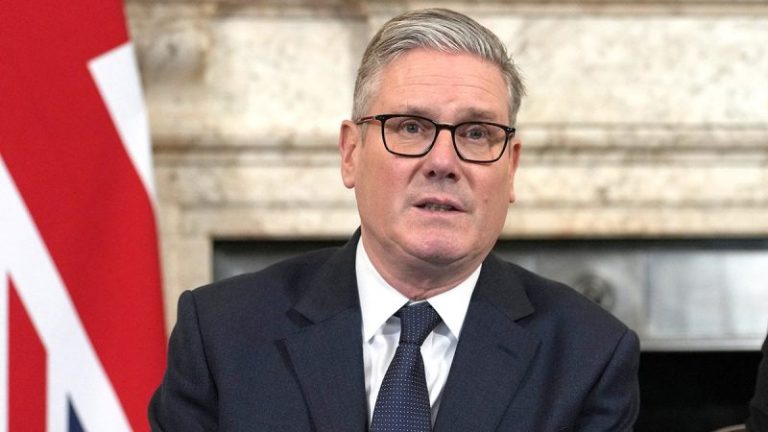
As the Russia-Ukraine war enters its fourth year since Moscow’s full-scale invasion in 2022, United Kingdom Prime Minister Keir Starmer referred to the ongoing conflict as ‘the most critical issue of our age,’ according to a press release announcing additional UK assistance for Ukraine.
‘On this grim anniversary, our message to the Ukrainian people is simple: Britain is with you, stronger than ever. That is why we are announcing new support today and we will continue to support Ukraine for as long as it takes,’ Starmer said, according to the press release.
‘For all the noise in world affairs today, this war remains the most critical issue of our age. It asks the question of whether Ukrainian and European freedom will endure. Our answer, together, is unequivocal. Russia is not winning this war. They will not win this war. Ukraine’s courage continues to hold the line for our shared values, in the face of Putin’s aggression,’ Starmer continued. ‘We will stand by their side, until a just and lasting peace – and beyond. Slava Ukraini.’
Former UK Prime Minister Boris Johnson has suggested that the Western World is ‘pussyfooting around.’
‘Putin will not stop the slaughter until he faces much greater pressure. So for heaven’s sake let’s get on with it. Impound his entire shadow fleet. Unfreeze all his frozen assets and give them to Ukraine. Give the Ukrainians the weapons they need to take out all the Russian drone factories. Do all of it now. Putin will not negotiate sincerely until he feels he has no choice,’ Johnson wrote in a post on X.
‘The Ukrainians fight like heroes while we in the West pussyfoot and delay. The West can end the war this year — if we stop pussyfooting around,’ he said.
President Donald Trump’s administration has been attempting to help broker peace between Russia and Ukraine.
In its statement, the UK government said the country’s security is closely tied to Ukraine’s fate and outlined new assistance, including £20 million (about $27 million) in emergency energy funding to help repair and protect Ukraine’s power grid and expand generation capacity.
The package also includes £5.7 million (around $7.7 million) in humanitarian aid for frontline communities, including people requiring evacuation and those affected by airstrikes or internal displacement, according to the release.

Four years into Russia’s full-scale invasion, the war in Ukraine has settled into a grinding conflict defined by high casualties and incremental territorial shifts. Russia still controls roughly one-fifth of Ukrainian territory, while Kyiv has recently clawed back limited ground in counteroffensives. Military estimates put Russian losses at about 1.2 million casualties since 2022, with Ukrainian losses between 500,000 and 600,000, underscoring the scale of attrition on both sides.
Diplomacy has intensified alongside the fighting. President Donald Trump met Russian President Vladimir Putin in Alaska last August for high-stakes talks aimed at advancing negotiations. Ukrainian President Volodymyr Zelenskyy has traveled to Washington multiple times since Trump returned to office, including a contentious Oval Office meeting in Feb. 2025 and a follow-up visit later in the year.
The most recent U.S. engagement with both sides came during trilateral negotiations in Abu Dhabi earlier this year and more taking place in Geneva on Feb. 17–18, where special envoy Steve Witkoff met with Russian and Ukrainian delegations as part of ongoing efforts to broker a settlement.
As the war enters its fifth year, former officials and analysts say the next phase could unfold along three possible paths: prolonged stalemate, shifting Ukrainian momentum, or a dangerous erosion of Western resolve.
The most immediate trajectory is continuation. The war remains defined by attrition, with neither side delivering a decisive blow and negotiations producing little progress.
Ret. U.S. Air Force Gen. Philip Breedlove, former NATO supreme allied commander of Europe, said Moscow is not winning despite its territorial hold, ‘There isn’t a winner right now.’
‘Russia, supposedly a world superpower with one of the world’s probably top three world armies and top four world air forces, in 12 years has gained about 20% of Ukraine. And they have lost some, say, over 1.2 million in the conflict so far. It’s a conflict that Ukraine is working hard to manage. It’s also a conflict that Russia is not, I repeat, not winning,’ he said.
Recent battlefield developments suggest another possibility. Breedlove pointed to rapid Ukrainian gains following disruptions in Russia’s command-and-control systems.
‘In the last three or four days, because of the loss of the Starlink command and control system, Ukraine launched an offensive, and they have snatched back months of Russian gains in three days, three-pronged push, hundreds of square miles regained, and Russia is backing up in several places right now.’
Carrie Filipetti, executive director of the Vandenberg Coalition, said such advances could shift leverage at the negotiating table. ‘Ukraine’s recent advances to recapture its territory is yet another signal that Putin’s war machine is continuing to atrophy as the world marks the fourth year of Russia’s full-scale invasion. Russia’s latest territorial losses shows that far from being invincible, Putin and his army are beginning to experience real failures in terms of capability and resources.’
She added that momentum matters. ‘Not only is this the most significant Ukrainian advance on the battlefield in more than two years, its importance may be felt even more concretely at the diplomatic table. Finding a lasting and equitable peace deal through negotiation is often about momentum – and right now the Ukrainians have it.’
If sustained, such gains could alter Moscow’s calculations and give Kyiv a stronger footing in negotiations as long as Ukraine has strong U.S. support, Breedlove argues, ‘The first thing and the most important thing Ukraine needs is a declaratory statement by the West and specifically by the United States that we are not going to allow Russia to win in Ukraine, and we will give Ukraine what it needs to stop Russia… where Putin hears it loud and clear and where the people of Russia hear it loud and clear that is a game changer. And I think that’s when Mr. Putin is going to have to make some tough decisions.’
A third path worries some Western strategists: that inconsistent support could prolong or tilt the conflict in Russia’s favor.
Heather Nauert, who served as spokesperson for the U.S. Department of State from 2017 to 2019, framed the war as more than a territorial dispute. ‘As we now enter the fifth year of Putin’s war in Ukraine, we’re reminded that this conflict has never been only about territory — it’s about identity, faith, and the future of a free nation. Russia has destroyed more than 600 churches, persecuted millions of Ukrainian Christians under occupation, and abducted more than 19,000 children in an effort to break Ukraine’s spirit. President Trump’s push for a lasting peace must be backed by strength and accountability – one that protects innocent lives, defends religious freedom and brings stolen children home.’
Ret. Lt. Gen. Richard Newton said deterrence remains central. ‘Four years into this horrific war, the fundamental lesson remains unchanged: Peace is only possible when strength shapes the terms. Putin will continue to savagely test our resolve until the costs of his aggression outweigh any possible gain.’
‘What Ukraine needs isn’t gestures from the world, but instead, unwavering support from the U.S. and Europe that convinces Moscow further advances carry unacceptable consequences,’ he argued. ‘Russia must not prevail against Ukraine and the West. What are needed are credible security guarantees, robust offensive and defensive capabilities and a unified, long-term commitment by the West to ensure deterrence isn’t an elusive goal, but a lasting reality.’
Breedlove warned that negotiations alone will not shift the balance. ‘The most dangerous scenario is that we do not do what we should do in Ukraine and Russia takes over Ukraine because they’re not done.We have a policy of peace through strength and we’re using it in Iran. We’ve used it in Venezuela. We’re using it with oil tankers around the world… But when it comes to Putin and Ukraine, we are peace through weakness.’
‘Mr. Putin is making a point that he’s in charge in Ukraine, not the West and certainly not America. And so we need to change that dynamic. You got good guys and you got bad guys. And right now the bad guys have told America to take a hike. So now, rather than telling them what to do, we are going to the good guys and saying, you have to give up more because the bad guys are not playing well in the sandbox. That’s peace through weakness, not peace through strength,’ Breedlove concluded.
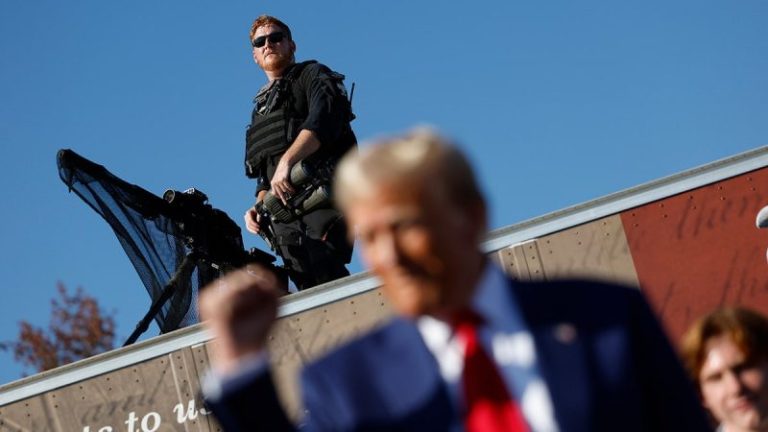
The U.S. Secret Service-involved shooting of a man with a shotgun inside the secure perimeter of Mar-a-Lago over the weekend brought the Department of Homeland Security’s partial shutdown into new focus.
Two USSS agents and a Palm Beach County Sheriff’s Office deputy confronted and later shot and killed Austin Martin, 21, who authorities said slipped through a vehicular exit gate that had opened for a car before brandishing his weapon.
‘They confronted a white male that was carrying a gas can and a shotgun. He was ordered to drop those two pieces of equipment that he had with him – at which time he put down the gas can, raised the shotgun to a shooting position… the deputy and the two Secret Service agents fired their weapons and neutralized the threat,’ according to Palm Beach County Sheriff Ric Bradshaw.
Those agents are among the many working their dangerous jobs without pay due to the ongoing partial shutdown of DHS, which Republicans say was brought on by Democrats’ demands that ICE, which remains funded through other means, be reformed.
Rep. Randy Fine, R-Fla., who represents Daytona Beach just up the coast from Mar-a-Lago, said the incident proves the bravery of the Secret Service no matter the circumstances.
‘The attempted assassination of President Trump at Mar-a-Lago is a stark reminder of growing leftist political violence in our country,’ Fine said in a statement.
‘Grateful to the Secret Service who neutralized the terrorist. Even as Democrats refuse to pay them because of their shutdown of the Department of Homeland Security, these men and women continue to stand their post.’
Top White House aide Stephen Miller offered an even more pointed response to the dynamic:
‘Democrats voted to defund Secret Service, Homeland Security Investigations (who partner with Secret Service) and all the intelligence and law enforcement functions that support Secret Service,’ Miller said.
‘Never before in history has federal law enforcement been purposefully defunded.’
House Small Business Committee Chairman Roger Williams of Texas added that Americans should take note of the agents who responded whether paid or not.
‘As we continue to learn more about the armed man at Mar-a-Lago this morning, we must remember that the brave agents who responded are serving our country without pay due to the Democrat-led shutdown,’ Williams, R-Texas, said.
Prior to the incident, Senate Majority Whip John Barrasso, R-Wyo., warned that the Secret Service and other agencies like FEMA would be put in a bad spot if the partial shutdown went forward.
‘Democrats are prioritizing illegal immigrant criminals ahead of the safety of the American people,’ he said in a February 12 floor speech.
At least one Democrat did react to the agent-involved shooting.
Rep. Lois Frankel of Florida, for whom Trump is technically a constituent at his Mar-a-Lago address, said that ‘political violence is never the answer.’
‘Thank you to the Secret Service and Palm Beach County law enforcement for their swift response today and for their continued work in keeping the president safe,’ Frankel said.
The Northeast blizzard presents separate challenges for resource-suspended agencies like FEMA, while certain Homeland Security-run services, such as TSA escorts for members of Congress, are also suspended.
Fox News’ Elise Oggioni contributed to this report.